Disclosure: Palvilla participates in the Amazon Services LLC Associates Program. As an Amazon Associate, we earn from qualifying purchases at no additional cost to you. Learn more.
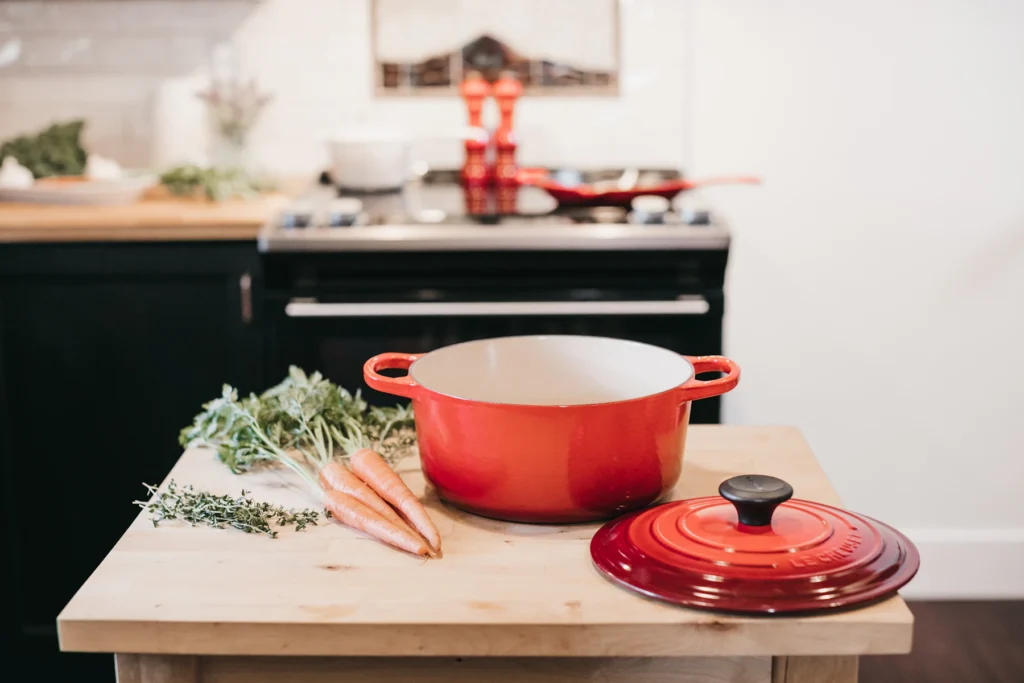
Few pieces of cookware are bought with the expectation that they will be handed down. A good enameled Dutch oven is one of them: it braises, bakes bread, simmers stock and goes from stovetop to oven to table. Le Creuset, founded in 1925, and Staub, founded in 1974, both cast theirs in France, both charge accordingly, and both have devoted followings.
The differences are real but specific. They come down to the color of the enamel inside the pot, how the lid handles condensation, weight, and how hot each can go. We compared the two best-selling 5.5-quart rounds on Amazon, then added one far less expensive option for cooks who want the format without the heirloom price.
How we evaluated
This is a Research-Based Evaluation. We have not cooked in these specific pots for this article. Our comparison rests on:
- Manufacturer specifications from each Amazon listing: capacity, weight, oven limits, care instructions and warranty.
- Design facts that can be checked: interior enamel color and texture, lid construction, knob material and country of manufacture.
- Owner patterns at scale from Amazon’s summaries of thousands of verified reviews, with particular attention to chipping, staining and weight complaints.
- Independent comparisons published by established food and lifestyle outlets, used to confirm or challenge the manufacturer claims.
Side by side
| Feature | Le Creuset 5.5 qt | Staub 5.5 qt |
|---|
| Interior enamel | Smooth, light sand color | Textured black matte |
| Lid | Tight-fitting; designed to circulate steam back to the food | Heavy lid with interior spikes that drip condensation evenly back onto the food |
| Oven limit (as listed) | 500°F | 900°F without lid; lid to 500°F |
| Weight (as listed) | About 11.2 lb (5.1 kg) | About 12.9 lb |
| Diameter (as listed) | About 10.2 in | About 11.8 in including handles |
| Made in | France | France |
| Care | Dishwasher safe per listing; hand washing extends the finish | Dishwasher safe per listing; hand washing extends the finish |
| Warranty | Limited lifetime | Limited lifetime |
| Price tier | $$$ | $$$ |
Specifications as published on the Amazon listings in October 2026. Weights and dimensions vary slightly by listing and color.
The pots, reviewed
Le Creuset Signature Enameled Cast Iron Round Dutch Oven, 5.5 qt
- Capacity5.5 quarts
- InteriorLight sand enamel, no seasoning needed
- Oven safeUp to 500°F (listed)
- WeightAbout 11.2 lb
- Made inFrance
- WarrantyLimited lifetime
The pale interior is the reason we recommend Le Creuset to most people. When you sear short ribs or sweat onions, you can see exactly when the fond turns from bronze to burnt, which is harder against a black surface. The enamel is smooth and slick from the first use, so it releases a stew without the scrubbing bare cast iron sometimes needs.
Le Creuset also wins on the human details: generously sized loop handles you can grip with thick oven mitts and a broad lid knob. The color range is the widest in the category, which matters when the pot lives on the stove. Amazon’s summary of roughly 3,000 owner reviews praises the heat distribution and performance on both stovetop and oven.
What to keep in mind
- The light interior shows staining and develops a patina over years; it is cosmetic, but it bothers some owners.
- A minority of owners report enamel chipping in normal use. Avoid metal utensils and thermal shock, such as cold water in a hot pot.
- Heavy for its size, though owners note it is lighter than some cheaper brands.
02Best for braising and bread
Staub Cast Iron Round Cocotte, 5.5 qt
- Capacity5.5 quarts
- InteriorTextured black matte enamel
- Oven safe900°F without lid; lid to 500°F (listed)
- WeightAbout 12.9 lb
- KnobNickel steel
- Made inFrance
Staub is built around the lid. Small spikes on its underside collect condensation and let it fall back onto the food in an even rain, which is why cooks who braise and pot-roast often prefer it. The lid is heavy and seals well, so long, low cooks lose less liquid.
The black matte interior has a fine texture that encourages browning and hides wear: years of use barely show. Its listed oven limit of 900°F without the lid, with a metal knob, makes it a strong choice for very hot bread baking. Owners in Amazon’s review summary describe the color as holding its shine over time and the pot as easy to clean and worth the price.
What to keep in mind
- The dark interior makes it harder for beginners to tell browning from burning.
- At about 12.9 pounds it is the heavier pot, and some owners find it a strain to lift when full.
- The handles are a little smaller than Le Creuset’s, which matters with bulky oven mitts.
Lodge Essential Enamel Cast Iron Dutch Oven, 6 qt
- Capacity6 quarts
- Oven safeUp to 500°F (listed)
- CareDishwasher safe; hand washing recommended
- Owner rating4.7 stars from 39,000+ Amazon ratings
- Made inChina (Lodge’s enameled line)
- Price tier$
If the pot is for Sunday stews rather than daily service, Lodge delivers most of what matters for a fraction of the French prices: enameled cast iron that holds heat, a moisture-sealing lid and a larger 6-quart capacity. With more than 39,000 Amazon ratings averaging 4.7 stars, it is one of the most widely owned Dutch ovens in the country.
What to keep in mind
- Owner reviews report enamel chipping more often than with the French brands, which is the main trade-off for the price.
- Lodge’s enameled cookware is made in China, unlike its American-made seasoned cast iron.
- Heavy, and the enamel finish is less refined at the rim and handles.
Our verdict: which one should you buy?
Choose Le Creuset if you are building your cooking confidence, cook a lot of sautéed and seared dishes where you need to watch the fond, or want the widest choice of colors.
Choose Staub if you braise often, bake bread at very high temperatures, or want an interior that will look the same in fifteen years.
Choose neither, for now, if you cook in a Dutch oven a few times a year. The Lodge does the same job, and the money saved can go toward a good chef’s knife.
Buyer’s guide: getting decades from enameled cast iron
Size
A 5.5-quart round feeds four to six and fits a standard oven with room for a loaf. Couples who rarely batch-cook are well served by 3.5 to 4 quarts; families who make stock or large braises should look at 7 quarts and up.
Heat
Enameled cast iron rarely needs high heat on the stovetop. Preheat gradually over medium, add fat before the pot gets very hot, and never heat it empty on high.
Avoid thermal shock
Do not plunge a hot pot into cold water or put a cold pot into a very hot oven. Sudden temperature changes are the most common cause of cracked or chipped enamel.
Cleaning
Soak, then wash with warm soapy water and a nylon brush. For stubborn stains on a light interior, a paste of baking soda and water usually works. Skip steel wool and harsh abrasives.
Utensils
Use wood, silicone or nylon. Metal spoons and whisks can mark or chip the enamel over time.
Frequently asked questions
Evidence basis
- Evaluation type: Research-Based Evaluation. PALVILLA has not personally tested these products.
- Sources: Amazon product listings and Amazon’s summaries of verified owner reviews for each pot (checked October 2026); manufacturer care guidance as listed; independent published comparisons of Staub and Le Creuset.
- Last reviewed: October 2026 · How we create our guides · Report an error
Al Sabri founded PALVILLA out of a lifelong love of homes and the artistry behind them: the line of a well-made sofa, the warmth of a brass fixture, the way good light changes a room. Based in Des Plaines, Illinois, he leads PALVILLA’s editorial direction and reviews our guides, pairing an eye for beauty with honest, research-based advice so readers can choose pieces they will still love years from now.
Researched and written by the PALVILLA Editors from manufacturer documents and owner evidence, with AI-assisted drafting and source checks. How we create our guides · Editorial standards